Virginia Home Grown
Fall Gardens for Small Spaces
Clip: Season 26 Episode 8 | 7m 41sVideo has Closed Captions
Explore a home garden in Richmond for practical tips on growing vegetables in the fall!
Peggy Singlemann visits Virginia Extension Master Gardener Phaedra Hise at her home garden in Richmond’s Oregon Hill neighborhood to discuss fall vegetables and learn strategies for growing in small spaces. Featured on VHG episode 2608, October 2026.
Problems playing video? | Closed Captioning Feedback
Problems playing video? | Closed Captioning Feedback
Virginia Home Grown is a local public television program presented by VPM
Virginia Home Grown
Fall Gardens for Small Spaces
Clip: Season 26 Episode 8 | 7m 41sVideo has Closed Captions
Peggy Singlemann visits Virginia Extension Master Gardener Phaedra Hise at her home garden in Richmond’s Oregon Hill neighborhood to discuss fall vegetables and learn strategies for growing in small spaces. Featured on VHG episode 2608, October 2026.
Problems playing video? | Closed Captioning Feedback
Where to Watch Virginia Home Grown
Virginia Home Grown is available to stream on pbs.org and the PBS app.
Providing Support for PBS.org
Learn Moreabout PBS online sponsorshipSo Phaedra, we're here in the fall, and yet you've got so many vegetables growing.
>>Yeah, this is a transition time where I've got my new fall things coming in, and then summer things like this tomato are on the way out.
>>And people don't think about that fall garden can be a transition time, but then it definitely moves on to fall.
>>Mhm, definitely.
And we'll be eating from this garden all winter long.
>>See, that's great.
And how do you pull that off?
>>Well, I do a lot of different things.
I make sure that I get my fall plants in early while I'm still eating from my summer green beans, onions, lettuces, arugula.
And so the fall plants are growing as the summer plants are kind of winding down.
>>And when you say early, are you thinking early August, or?
>>Late August, yeah, mid to late August.
>>Okay, okay.
I see a small space here, and it's very tightly planted.
Some people are intimidated by small spaces.
So what's your approach?
>>Close planting, especially for leafy greens, which I tend to grow a lot of like lettuces and arugula, it's called intercropping.
When you plant something small or seeds even underneath a larger plant that has got a little bit of life in it, but it's going to be going out soon.
And by the time that happens, your new plant has come up and they can share that space.
>>Plus the old plant will shade a little bit because of the heat of the summer.
>>Exactly.
And when you're talking about August in Virginia, I mean, honestly, one reason I love fall gardening, the summer now with global warming is just too hot.
Everything dies in July and August.
So honestly, September is a really nice time to start bringing the garden back to life.
>>Truly, truly.
And some of the choices you have here, you were saying that here in this garden in front of us, a small raised bed, you're having problems with enough sunshine.
>>So we're in the city, I'm in Oregon Hill, and I get barely six hours of sunshine a day here, which is really a hard cutoff point for vegetables, especially fruiting vegetables.
They need a lot of energy from that sun.
So here I have more success with leafy greens.
And so I grow kale, collards, lettuces, arugula, chard.
When I do want to grow a fruiting vegetable like a cucumber or a tomato, I go vertical and I send everything up so that it gets more sun as it gets higher.
And then I can have flowers also interspersed in the lower area, and they're not competing with the vegetables.
The vegetables have gone up and they've got that space up high.
>>But you do have a full sun area here, you were mentioning, in the front of your house.
>>I do.
In the front, it's southern exposure.
It's full sun.
And so I have put an asparagus bed up front.
I grow arugula up front.
I have a lot of Italian herbs, which love a hot, dry environment.
So I take advantage of that where I have it.
>>But let's swing it back to this bed here in front of us.
What are some of the practices that you've taken on to extend this through the winter?
>>You see the hoops here?
One thing I do is I will put an insulating cloth.
It's a white lightweight fabric.
The snow will hit on it, the hoops keep it from collapsing onto the plants.
And that creates a little bit of a microclimate that's a little warmer than the area out here.
So they will thrive really well in that space.
>>Yeah, and knowing that you have shade trees around here will have no leaves on the trees, so you actually get more sun to this space through those winter months.
>>In the winter, absolutely.
And one thing that happens, if I get something in late and it doesn't grow quite where I want it to be in the fall, what does happen is in February, it really takes off, because as you say, there's no leaves on the trees.
The days start to lengthen, and so my collards and my kale will just explode.
And so I have something to eat.
>>So you're filling in that gap.
>>The hungry gap, they call it sometimes, yeah.
I have a lot of stuff that happens during that time.
>>For soil amendments, I see the compost bin.
How much do you do here in the city to adjust the soil?
>>It's one reason I have a raised bed, because when you're in the city, you don't always know what the soil composition is.
So I like to go up.
I put compost on once a year, usually in the winter, and I will just let that, a couple of inches of compost on the surface and I just let it go in.
I don't dig, I do no dig gardening.
I want that soil to build a really nice network of mycorrhiza in there so that everything is happy and getting nutrition.
So yeah, once a year putting an inch or two of compost on top.
>>But the beds along the driveway, they are not raised.
>>The driveway beds closest to the alleyway, I don't grow vegetables actually because of that.
And because the alleyway is a very busy alleyway with a lot of traffic, there's car exhaust that comes in.
Generally, I like to be 10 feet away from an active road surface.
Closer to my garden, I actually do know the composition of that soil because it used to be part of my driveway.
We shifted the fence, and so I knew what that soil was like, I tested it, and so I'm comfortable growing vegetables there.
>>Fantastic.
And then I see at the end of your driveway here, you have a beautiful fig.
>>The fig, thank you.
>>How are you able to pull that off with that marginal sun?
>>So the fig is in a location where it also gets morning sun.
And so the fig, which does like a lot of sun, is pretty happy here.
And then the second thing I do to maximize the sun exposure is I espalier the fig, which means I'm pruning it back pretty hard to be a couple of minimal cordons that go out sideways.
And what that means is there's not a lot of growth of existing branches blocking sun to those few branches that come up with the figs on them.
So it makes sure that what little sun there is, is really concentrated on the fruit.
>>Excellent.
That's an old tried and true method.
It's been around for centuries.
>>Right, right.
>>A way, particularly in colder climates, is to get fruit trees to grow with a warm wall.
>>Against a warm wall.
Exactly.
And it takes advantage of space, which in the city I have very little space.
And you can really do it with any fruit tree.
You can do it with ornamental trees.
I've seen it done with magnolias where it looks absolutely beautiful.
It's just a great way to take advantage of space and get more sun.
>>Absolutely.
What type of advice would you give, not a new gardener, but even a seasoned gardener for growing in small spaces?
>>Yeah, we have a very, I'm in Richmond City, and the space is very, very small.
A couple of pieces of advice.
One is to go vertical.
I definitely try to go vertical as much as I can, because it takes less space and the plant will get more sun as it gets taller.
So I use trellises for that.
The other thing is you may not know what happened in the soil in your space, and so soil testing is really important so you can identify the nutritional value of the soil, the pH of the soil.
But also you don't know the history of that space, especially in an urban setting, and so I do a raised bed.
And I compost once a year in the winter.
And then the other piece of advice that I give people is honestly just try it.
Like, it takes maybe two or three years for you to get familiar with your space and to understand what performs well in that space.
For example, the sun is a big issue.
You absolutely need to know how many hours of sun you get for that space.
And ideally, you want to know what direction the sun is coming from, because what plants really want is morning sun and then some afternoon shade.
So six hours of morning sun and then a nice cool afternoon, just like a person would want, that's what they want ideally.
If that's not what you have, you can still make it work.
It's not what I have here.
I have a lot of afternoon sun and I still can grow a lot of leafy green vegetables.
But know the sun in your space and then just give it a shot and try things.
>>That's fantastic.
Well, Phaedra, I appreciate you showing us your beautiful garden here.
And you know, so many people can garden in a small space.
They just have to kind of expand their imagination a little to be able to figure out where they can fit plants here and there so they can have wonderful, healthy vegetables that they grew to enjoy.
>>Exactly.
We eat out of our garden every single day.
>>See, and that's a joy.
Thank you.
>>Thanks so much for coming.
 New
Video has Closed Captions
Clip: S26 Ep8 | 5m 41s | Get tips for packing pumpkin flavor into your fall treats! (5m 41s)
 New
Video has Closed Captions
Clip: S26 Ep8 | 6m 52s | Learn the differences in bulbs, tubers and corms! (6m 52s)
 New
Harvesting Hibiscus & Lemongrass
Video has Closed Captions
Clip: S26 Ep8 | 3m 51s | Get tips for harvesting and storing fall produce from your garden! (3m 51s)
 New
How to Make a Fall Flower Arrangement
Video has Closed Captions
Clip: S26 Ep8 | 3m 27s | Make a unique fall centerpiece inside a pumpkin! (3m 27s)
 New
Video has Closed Captions
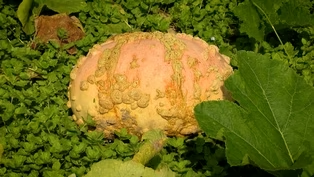
Clip: S26 Ep8 | 7m 28s | Discover the huge variety of pumpkins and other fall gourds available to growers today! (7m 28s)
Providing Support for PBS.org
Learn Moreabout PBS online sponsorship










Support for PBS provided by:
Virginia Home Grown is a local public television program presented by VPM